
Energy Storage

A better fit for advanced nuclear.

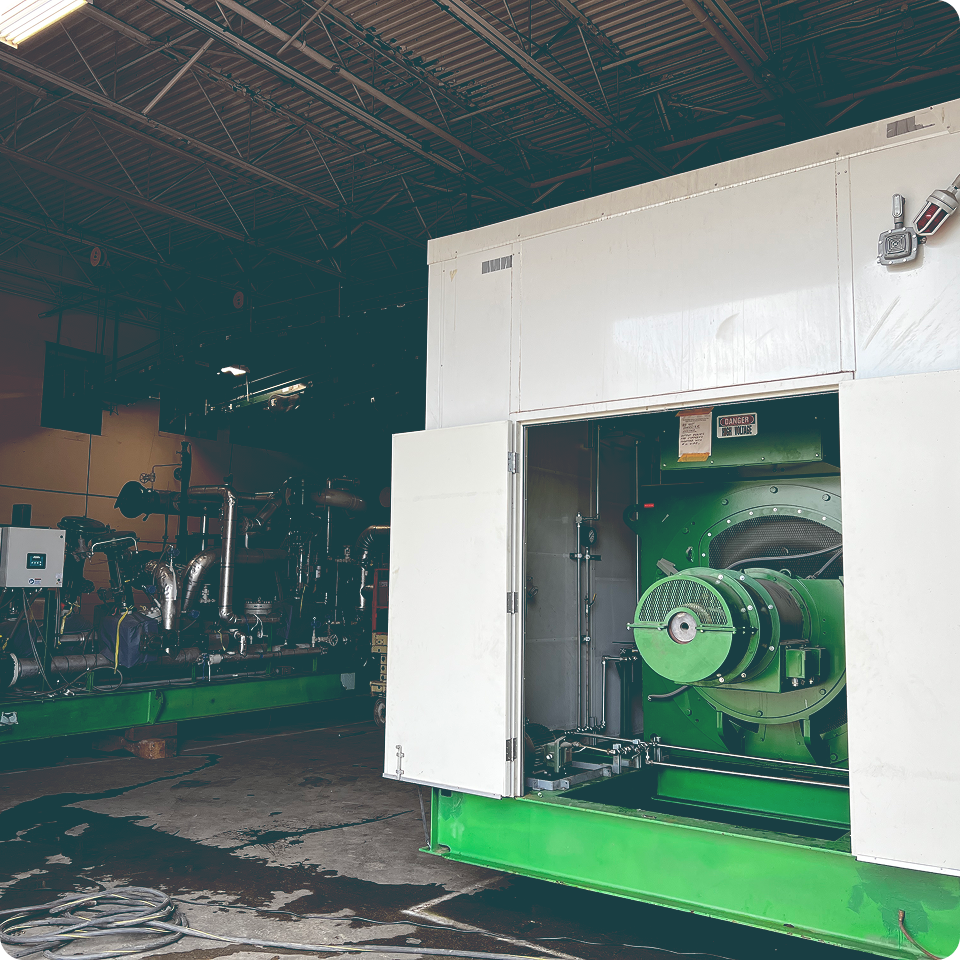
Advanced reactors are becoming smaller, more modular, and more flexible. Steam-based systems, designed for large centralized plants, can undermine those same attributes through water dependence, larger footprint, and operational complexity. Echogen's supercritical CO₂ (sCO₂) power conversion technology is designed to support the evolution of reactor design through compact equipment, water-free operation, and modular deployment.

Heat in. Electricity out. This power cycle does the
heavy lifting.

Advanced reactors are becoming smaller, more modular, and more flexible. Steam-based systems, designed for large centralized plants, can undermine those same attributes through water dependence, larger footprint, and operational complexity. Echogen's supercritical CO₂ (sCO₂) power conversion technology is designed to support the evolution of reactor design through compact, skid-based equipment, water-free operation, and modular deployment.

Connected through a primary heat exchanger rather than directly to the reactor core, the system remains isolated from direct radiation exposure while supporting reactor temperatures ranging from 400°C to 900°C. Built on more than two decades of sCO₂ expertise, the result is a practical power conversion platform designed specifically for advanced nuclear applications.

Echogen is exploring direct heat exchange between the reactor coolant and the CO2 as a nextgen opportunity to improve performance further

Compact by design

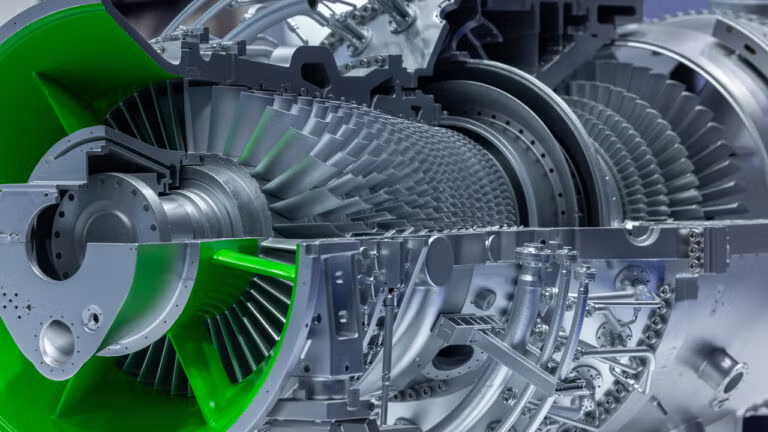
Advanced nuclear is moving toward smaller, modular reactor architectures. Echogen's highly compact turbomachinery is 4x more compact than comparable traditional steam turbomachinery, reducing footprint and infrastructure requirements.

Built for flexibility

Multiple cycle configurations and skid-based deployment support a wide range of reactor sizes, thermal loads, and deployment models.

Compatible across reactor pathways

The primary heat exchanger interface can be integrated with gas-cooled, metal-cooled, molten salt, heat-pipe, and water-cooled reactor technologies.

ADVANCED NUCLEAR POWER CYCLES

Why advanced nuclear developers are exploring sCO₂.

Traditional steam systems were developed for large, centralized power plants. Advanced reactors are pursuing a different path, emphasizing modularity, flexibility, and simplified deployment.

Echogen's sCO₂ power conversion technology aligns with those goals through a compact architecture, water-free operation, and compatibility across multiple reactor designs.
Smaller footprint

Highly compact turbomachinery reduces overall system size and supports deployment models where space and infrastructure requirements matter.

Water-free operation

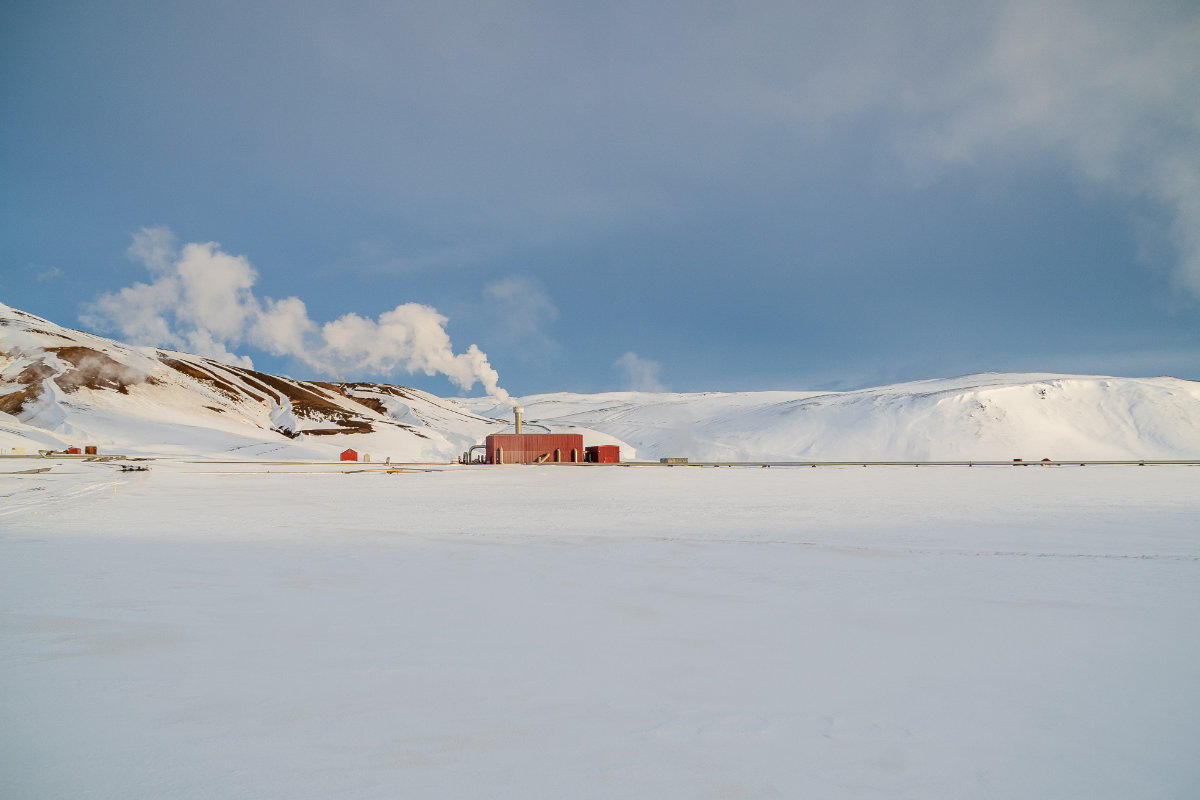
The closed-loop system eliminates the water requirements associated with traditional steam-based power conversion systems, enabling deployment in arid climates, arctic environments, and sites where water access is constrained or operationally sensitive.
Modular deployment

Multiple cycle layouts and skid-based installation support factory-built and modular reactor approaches.


Key benefits
Higher Cycle Efficiency
The sCO₂ power cycle delivers higher cycle efficiency than other advanced power cycles considered for nuclear reactor applications, particularly at the higher operating temperatures characteristic of advanced reactor designs.
Fast Ramp Rates
Designed to respond quickly to changes in reactor thermal output while operating across a wide range of thermal capacities and loads.
Low-Staffing Operation
The closed-loop CO2 architecture eliminates water chemistry management, corrosion monitoring, and wet-environment maintenance that drive staffing requirements in steam plants.
Wide Operating Range
The system can operate across a broad range of thermal loads associated with advanced nuclear reactors, including SMRs and microreactors.
Potential Thermal Storage Integration
The system offers the potential to integrate thermal storage as part of future energy systems.
Reduced Infrastructure Requirements
Compact equipment and streamlined system architecture help reduce balance-of-plant requirements compared with traditional steam-based approaches.
Proven Technology Development
Built on more than 20 years of supercritical CO₂ power conversion development, testing, and deployment.
Reactor Compatibility
Designed to integrate across multiple advanced reactor technologies through a common primary heat exchanger interface.
APPLICATIONS

Power conversion that works across reactor technologies.

Microreactors
Supports highly compact deployments where footprint, operational simplicity, and flexibility are critical.
Small Modular Reactors (SMRs)
Aligns with factory-built and modular deployment models while reducing supporting infrastructure requirements.
Gas-Cooled Reactors
Supports high-temperature operation through a compact closed-loop architecture.
Metal-Cooled Reactors
Compatible with advanced reactor designs through secondary or tertiary loop configurations.
Molten Salt Reactors
Designed to integrate with high-temperature reactor systems through a primary heat exchanger interface.
Heat-Pipe Reactors
Flexible cycle configurations support a broad range of reactor technologies and operating conditions.
Explore Approach

Frequently
Asked 

Questions

What are the benefits of using an sCO₂-based power cycle for nuclear 
reactors?

The sCO₂ power cycle is a very compact system with higher cycle efficiency than any other advanced power cycle considered for nuclear reactors.The power cycle can be designed in various cycle-layout configurations and as a modular system.The sCO₂ power cycle is a closed system without a direct connection to the reactor core, so there is no effect of radiation on the working fluid (CO₂).

How is the power cycle connected to a nuclear reactor?

The sCO₂ power cycle is connected to the nuclear reactor via a primary heat exchanger. The primary heat exchanger serves as the interface between the reactor coolant (e.g., helium, sodium, water, etc.) and the power cycle.

The power cycle can be configured as either a secondary loop or a tertiary loop.

The primary heat exchanger interface can be used with any advanced nuclear reactor, including gas-cooled, metal-cooled, molten salt, heat-pipe, and water-cooled reactors.

Can the system be designed as a modular system like an SMR?

Yes. The sCO₂ power cycle is a highly versatile system with different cycle-layout configurations that can be adapted to fit any size and number of nuclear reactors.

The power cycle is a very compact system, particularly with respect to the turbomachinery.

What is the operating range of an sCO₂-based power cycle for nuclear reactors?

The system can operate with any thermal load associated with advanced nuclear reactors, including SMRs and MMRs.

The power cycle can operate with heat-source (i.e., nuclear reactor) temperatures ranging from 400°C to 900°C.

Is there any potential impact of radiation on the working fluid?

There is no direct radiation exposure because the system is a closed loop connected to the primary (reactor) loop through a primary heat exchanger.

CO₂ does not flow directly through the nuclear reactor.

How quickly can Echogen’s power cycle be deployed?  

Echogen has been embracing advanced manufacturing methods to accelerate supply of traditional long lead time components. That in combnination with a Frame approach to product development allows for lead times on early articles within 16-18 months, and then driving down to ~9 months with a mature offering.

CURRENT NEWS + EVENTS

Check out what's happening at Echogen.